
There is a quiet but powerful shift underway.
Across the United States and much of the developed world, people are experiencing a strange combination of conditions: rising housing costs, increasing loneliness, declining trust in institutions, and a growing sense that the traditional paths to meaning and stability are no longer reliable.
At the same time, new tools—especially artificial intelligence—are dramatically increasing the capabilities of individuals and small groups.
These forces are converging toward a new model of organizing human life:
Intentional communities.
Not as fringe experiments.
Not as countercultural retreats.
But as a prominent and scalable business model of the future.
The Conditions Are Set
Start with the need.
Housing has become unaffordable for large segments of the population. Young professionals delay homeownership. Families stretch finances to maintain stability. Entire regions experience pricing distortions driven by supply constraints and capital flows.
At the same time, people are more isolated than ever. Social trust is low. Friendships are thinner. Many people live physically close to others but lack meaningful connection.
Meanwhile, traditional institutions that once provided structure—churches, universities, civic organizations—are struggling to adapt. Participation declines, costs rise, and their ability to deliver meaning or coordination weakens.
This creates a vacuum.
And vacuums do not remain empty.
A Return to an Older Model—With New Tools
Intentional communities are not a new invention. They are a rediscovery.
Monasteries organized life around shared spiritual discipline.
Colleges brought together learning, living, and identity formation.
Early communes and cooperatives experimented with shared economic life.
Even corporate campuses and company towns, for better or worse, attempted to integrate work and living.
What is new is the technological and economic context.
Small groups can now:
- Coordinate complex operations digitally
- Access global knowledge instantly
- Generate income remotely
- Replace institutional functions with software and lean teams
The result is something fundamentally different:
Communities that function as fully integrated life systems—without requiring the scale of traditional institutions.
From Housing to the “Life Stack”
The biggest mistake is to think of this as a housing trend.
It is not.
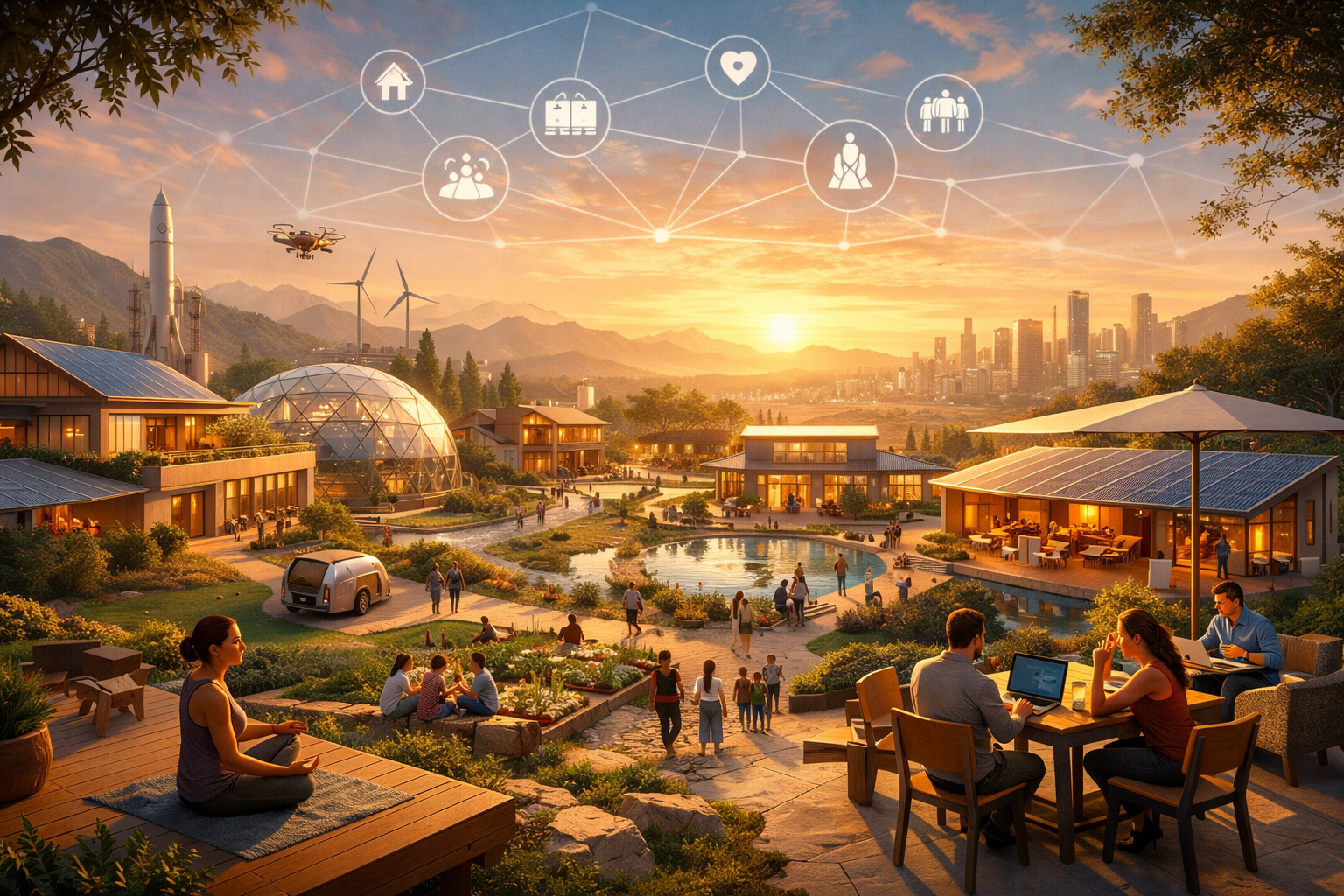
What is emerging is a new model that integrates multiple dimensions of life into a single system:
- Housing
- Work
- Education
- Social life
- Health and wellness
- Spiritual exploration
- Governance
This is a full-stack approach to living.
Instead of navigating fragmented systems—commuting between home, office, gym, social spaces, and institutions—people increasingly seek environments where these elements are integrated and aligned.
Intentional communities offer exactly that.
The Economic Engine: Community as a Business
For this model to scale, it must be economically viable.
The emerging insight is that communities themselves can operate as businesses.
Revenue streams may include:
- Residential membership or rent
- Education programs and workshops
- Remote work hubs and professional services
- Wellness and retreat offerings
- Content and media production
- Startup incubation and venture collaboration
In this sense, the community becomes a platform.
Not just a place where people live—but a system that produces value.
You might think of this as:
Community-as-a-Service
Or more simply:
A residential platform that generates economic, social, and cultural output.
Alignment as the Core Advantage
Traditional cities optimize for scale.
Intentional communities optimize for alignment.
This is a critical distinction.
When people share:
- Values
- Goals
- Lifestyles
- Intellectual frameworks
They reduce friction and increase cooperation.
The result is a powerful dynamic:
Proximity + alignment = accelerated output
This is why universities, research labs, and innovation hubs have historically been so productive. Intentional communities can replicate—and potentially surpass—these dynamics in more flexible and targeted ways.
AI and the Rise of Small, High-Capability Groups
One of the least discussed but most important drivers of this trend is artificial intelligence.
AI dramatically reduces the cost of:
- Administration
- Research
- Content creation
- Education
- Business operations
This means that small communities can operate with the sophistication of large organizations.
A group of 20–100 people, properly organized and equipped with modern tools, can now:
- Run businesses
- Educate themselves and others
- Produce media
- Manage finances and governance
- Coordinate complex projects
This would have been extremely difficult just a decade ago.
The Hard Problem: Governance
If there is one area where intentional communities consistently struggle, it is governance.
Key questions include:
- Who makes decisions?
- How are conflicts resolved?
- How is culture maintained over time?
- How do people enter and exit the community?
Poor governance leads to dysfunction, stagnation, or collapse.
The future of intentional communities will depend heavily on innovation in this area:
- Hybrid leadership models
- Clear constitutions and norms
- Transparent decision-making systems
- Mechanisms for accountability and renewal
Designing governance is not an afterthought—it is central to the model.
Physical Space Meets Digital Coordination
The most successful communities will not be purely physical or purely digital.
They will be both.
Physical space provides:
- Depth of connection
- Shared experience
- Embodied life
Digital systems provide:
- Coordination
- Scalability
- External reach
Together, they form a hybrid model that combines the strengths of both.
A Market of Many Communities
There will not be one dominant model.
Instead, we are likely to see a diverse ecosystem of intentional communities tailored to different needs:
- Professional communities focused on entrepreneurship and innovation
- Spiritual communities centered on faith and discipline
- Wellness communities oriented around health and lifestyle
- Family-oriented communities providing shared services and stability
- Ideological or mission-driven communities organized around specific beliefs
Each will serve a different segment of the population.
Why Now
The timing is not accidental.
The conditions are converging:
- Economic pressure is forcing new living arrangements
- Social fragmentation is driving demand for belonging
- Institutional decline is creating open space
- Technology is enabling new forms of coordination
At the same time, there is a growing desire for something deeper:
Not just convenience.
Not just efficiency.
But purpose, identity, and shared direction.
Risks and Realities
This model is not without risk.
Intentional communities can fail in predictable ways:
- Poor leadership or governance
- Financial instability
- Social conflict
- Excessive ideological rigidity
- Regulatory and zoning challenges
There is also the risk of exploitation or insularity.
These are not trivial concerns. They must be addressed directly and thoughtfully.
A Shift in How We Organize Life
For much of the 20th century, the dominant institutions of society organized people around employment.
Where you worked determined where you lived, how you spent your time, and often your identity.
That model is weakening.
In its place, a new organizing principle is emerging:
Shared purpose.
Intentional communities are one of the clearest expressions of this shift.
They offer a way to align:
- Where you live
- What you work on
- Who you spend time with
- What you believe
Into a coherent system.
Closing Thought
We may look back on this period as a transition point.
A moment when individuals, empowered by new tools and responding to new pressures, began to reorganize themselves into smaller, more aligned, more intentional forms of community.
Not as an alternative to society.
But as the next version of it.
Additional Concepts to Potentially Explore (Not Included Above)
- Legal structures (co-ops, land trusts, zoning reform)
- Financing models (fractional ownership, tokenization, shared equity)
- Insurance and risk pooling within communities
- Education models (micro-schools, apprenticeship systems)
- Role of religion vs secular spirituality in community formation
- Inter-community networks and federations
- Migration patterns (rural revival, secondary cities)
- Environmental sustainability and land use
- Security and resilience (food, energy, local systems)
- Brand and identity as a driver of community growth
- Exit liquidity for members (how people leave financially/socially)
- Case studies of modern communities (co-living startups, retreats, startup houses)
- Demographic trends (declining birth rates, delayed family formation)
- International variations (U.S. vs Europe vs Asia models)