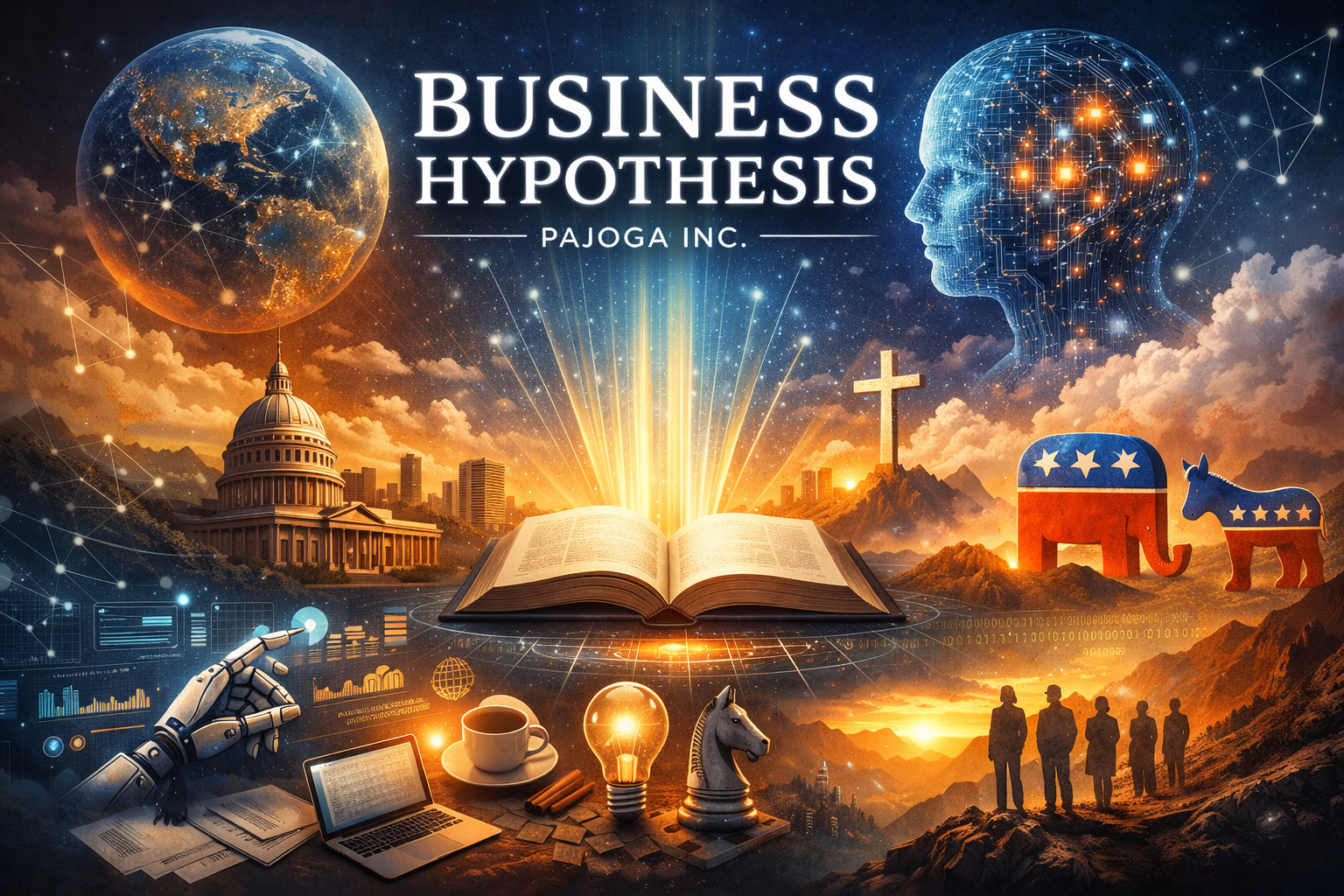

Pajoga exists to pursue clarity in a time of confusion. The modern information environment rewards speed, outrage, tribalism, and shallow takes. It penalizes nuance, humility, and patient inquiry. The work published here is guided by a different set of commitments.
Below are the principles that shape how I think, write, and engage.
A Genuine Effort to Rigorously Seek Truth and Report Honestly
Truth-seeking is not a slogan; it is a discipline. It requires the willingness to examine evidence carefully, to question assumptions — including one’s own — and to resist the comfort of prepackaged narratives.
Rigor means reading primary sources when possible. It means distinguishing between data and interpretation. It means acknowledging when conclusions are provisional. It means avoiding the temptation to overstate certainty for rhetorical effect.
Honest reporting does not mean neutrality in the sense of moral indifference. It means intellectual integrity: saying what appears true based on the best available evidence, even when inconvenient.
The goal is not to win arguments. It is to better understand reality.
Transparency About Biases, Uncertainties, and Conflicts of Interest
Every writer has priors. Every analyst has preferences. Every human being carries assumptions shaped by experience.
Rather than pretend to be free of bias, the responsible approach is to disclose it. When relevant, I aim to make clear:
- My philosophical leanings
- My personal connections
- The limits of available data
- Where I may be speculating
Uncertainty is not weakness; it is honesty. Confidence without qualification is often a signal of shallow thinking. Complex systems deserve humility.
Transparency builds trust not because it eliminates bias, but because it makes the reader aware of it.
Faith and the Contemplation of God as Foundational
Human systems — markets, governments, media — are important, but they are not ultimate. At the core of well-ordered life is the recognition that human beings are moral and spiritual creatures.
Faith, contemplation, and reflection on God orient our understanding of dignity, responsibility, freedom, and sacrifice. They temper ego. They remind us that efficiency and power are not the highest goods.
This site does not exist to proselytize. But it does operate from the conviction that serious thought about society must grapple with ultimate questions: What is a person? What is justice? What is the good life?
Without that grounding, analysis risks becoming technocratic and hollow.
Freedom as Essential to a Moral and Prosperous Society
Freedom is not merely a political preference; it is a moral condition. A society that does not protect freedom — of speech, conscience, association, enterprise — cannot sustain dignity or innovation.
Economic freedom enables voluntary cooperation. Intellectual freedom enables discovery. Religious freedom enables conscience.
Freedom also demands responsibility. It presumes that individuals are capable of choice and accountable for their actions.
History repeatedly demonstrates that prosperity and human flourishing correlate strongly with systems that protect liberty. This is not accidental.
The Centrality — and Fragility — of Local Relationships
Well-being is not produced primarily by institutions or abstractions. It is built in families, neighborhoods, churches, voluntary associations, and small businesses.
Personal relationships anchor identity and accountability. They create meaning. They provide mutual support in ways centralized systems cannot replicate.
Yet local relational networks appear to be in decay — weakened by mobility, digital distraction, economic concentration, and cultural fragmentation.
Healthy societies require vibrant local communities. Strengthening those bonds is not nostalgia; it is practical necessity.
Voluntary Organizing as the Superior Delivery Mechanism
Markets and businesses are not perfect. But voluntary exchange — when genuinely voluntary and rule-bound — remains the most effective mechanism for delivering goods, services, and innovation at scale.
Why? Because voluntary systems:
- Harness dispersed knowledge
- Reward value creation
- Penalize inefficiency
- Adapt dynamically
Centralized systems often lack these feedback loops. They tend toward rigidity and politicization.
This does not mean government has no role. It does mean that wherever possible, solutions grounded in voluntary cooperation tend to outperform coercive ones in both efficiency and moral legitimacy.
Focus on the Important
The modern media ecosystem is optimized for the urgent, not the important.
Outrage cycles dominate attention. Viral controversies crowd out structural issues. The loudest voices crowd out the most careful ones.
This site aims to prioritize:
- Long-term structural dynamics
- Incentive systems
- Institutional design
- Cultural undercurrents
If a topic is emotionally intense but strategically trivial, it may not deserve extended attention. Depth requires selectivity.
Gratitude for Civilization — and a Commitment to Stewardship
Modern life is easy to criticize. It is harder to appreciate.
Human civilization — particularly the American experiment — has produced extraordinary advances: constitutional governance, widespread literacy, technological innovation, rising life expectancy, and unprecedented prosperity.
The United States, despite real flaws and contradictions, remains one of history’s most remarkable political and economic experiments. Its constitutional framework, commitment to individual rights, and tradition of voluntary association have enabled extraordinary achievement.
Gratitude does not mean denial of problems. It means recognizing inheritance — and feeling responsibility to steward it well.
Critique is valuable only if paired with a commitment to continuation and improvement.
A Counter to the Distortions of the Media Ecosystem
Today’s information environment rewards:
- Shallow takes
- Hysterical framing
- Outrage amplification
- Tribal reinforcement
These incentives distort perception. They exaggerate division. They reduce complex issues to caricatures.
Pajoga aims to serve as a counterweight:
- Slower, not faster
- Analytical, not hysterical
- Independent, not tribal
- Constructive, not performative
The ambition is modest but serious: to contribute clarity where there is noise, and substance where there is spectacle.
Closing
These editorial values are aspirational. I will not always live up to them perfectly. But they serve as a compass.
In an age defined by fragmentation and velocity, deliberate thought is an act of discipline. Honest inquiry is an act of service. And careful attention to what truly matters is an act of respect — for readers, for community, and for the civilization we inherit.
I