

We live in the most connected era in human history, and somehow the most divided. Worldviews have hardened into fortresses. People fuse their identities to their positions, and every disagreement starts to feel like a threat to the self. In a climate like this, it is tempting to treat every competitor and every opposing force as an enemy to be beaten, ideally into a fine powder.
The stronger move is the opposite one. Treating opponents with charity is not softness or naïveté. It is one of the most durable strategic advantages available to anyone who works, builds, or leads. The reason is simple: the opposition usually knows something worth knowing, and the discipline of taking it seriously is what separates organizations that learn from those that merely defend themselves. What follows are a few principles for putting that discipline to work.
Even rivals share higher ground
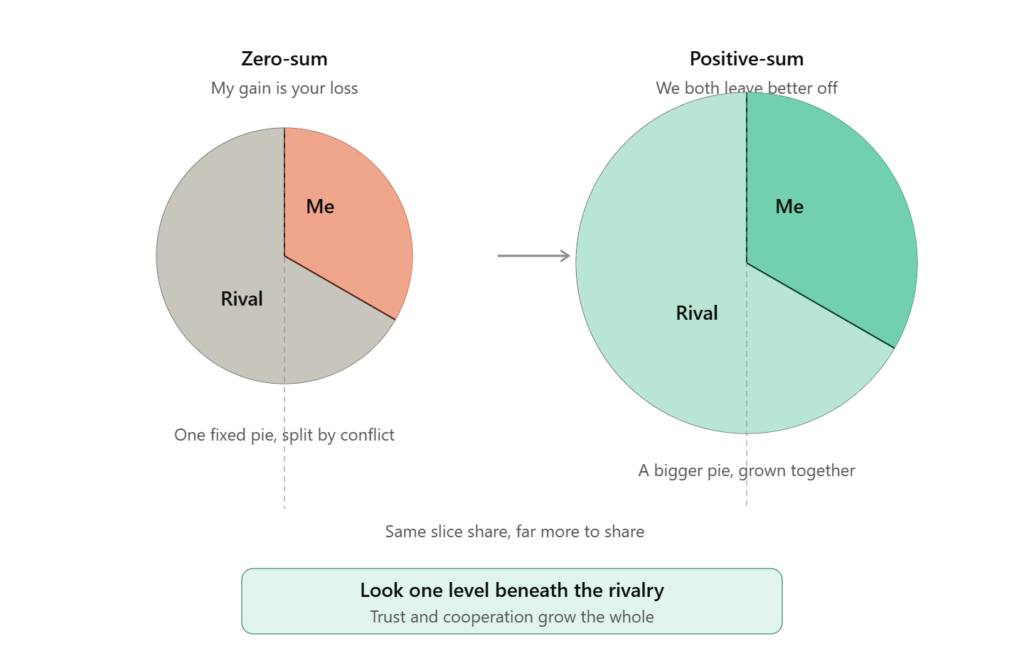
Fragmentation is real and should not be waved away. But beneath almost every rivalry there is usually a plane where cooperation pays for both sides: a market both parties want to grow, a standard both benefit from adopting, a reputation for fair dealing that makes everyone easier to work with.
The mistake is to assume competition is zero-sum, meaning that for one side to gain, the other must lose an equal amount. Most real relationships are not built that way. They are positive-sum: through exchange, specialization, and cooperation, the total available value grows, and both parties can leave better off than they arrived. Seeing the positive-sum layer beneath a rivalry is not wishful thinking. It is simply looking one level deeper than the surface conflict, which is one level deeper than most people bother to look.
The opposition sees what you cannot
Here is the humbling part. A competitor exists, and persists, because it has noticed something others may have missed: a customer need someone dismissed, an inefficiency someone tolerated, a risk someone waved off. Its continued survival is evidence that some part of its view is correct.
John Stuart Mill made the enduring case for this in On Liberty in 1859. Silencing an opposing opinion, he argued, robs us either way. If the opponent is right, we lose the chance to trade error for truth. If the opponent is wrong, we lose the sharper, livelier understanding of our own position that only comes from defending it against a real challenge. An opinion never tested against its strongest opposition, Mill warned, is held as dead dogma rather than living truth.
Charity toward opponents, then, is a form of intelligence gathering. Engaging the strongest version of the other side’s argument, rather than the weak caricature that is easier to knock down, is how an organization finds its blind spots before they become expensive. The caricature is more satisfying to argue with, of course, since it never fights back. It is also useless.
Goodwill runs with the grain
There is a case to be made that trust, generosity, and goodwill are not merely nice-to-haves layered on top of hard-nosed business. They are structural. They compound. They run with the grain of how markets actually work rather than against it, and over a long enough horizon they tend to win.
This is not just sentiment. The political economist Francis Fukuyama, in his 1995 book Trust, argued that a society’s prosperity depends heavily on the level of trust its members extend to one another. High-trust environments, he showed, save enormously on what economists call transaction costs, meaning the friction of contracts, monitoring, and enforcement that low-trust parties must pay simply to do business at all. When people can rely on one another’s goodwill, they coordinate faster, build larger, and create more. Trust, in his account, is not a moral luxury. It is economic infrastructure.
None of this requires adopting anyone’s philosophy or creed to see the pattern. The principle is better demonstrated through how one operates than announced in a way that alienates those who see the world differently. The deepest things tend to be shown rather than declared, and nobody has ever been won over by a pop-up ad for someone else’s convictions.
Trust, up to a point
The obvious objection is that kindness gets exploited. Malicious actors exist. Extend trust indiscriminately and someone will eventually take advantage of it. This is true, and any principle that ignores it deserves to be ignored.
But consider one of the most studied lessons in the theory of cooperation. When strategies compete over many rounds of interaction, the ones that win over time are not the ruthless ones. They are strategies that start out cooperative, retaliate against betrayal so they cannot be endlessly exploited, and then forgive quickly and return to cooperation. Nice, but not a pushover. The lesson is not blind faith. It is generous reciprocity with a spine.
That is the calibration worth aiming for. Err on the side of trust, because the compounding returns of being someone others want to deal with far outweigh the occasional cost of misjudging a bad actor. But keep the memory and the boundaries that stop generosity from becoming an open invitation. Being the nicest person at the table is admirable. Being the easiest to fleece is a different thing, and the two are not required to travel together.
The open-source software movement is perhaps the clearest proof that this works at scale. Fierce commercial rivals, companies that compete hard in the market, pour resources into shared code that any of them, and all of their competitors, can freely use. The Linux kernel, which now runs a vast share of the world’s servers, phones, and infrastructure, was built this way, by people and firms who chose to contribute to a commons rather than hoard. They bet that a rising, shared foundation would lift them higher than a smaller, private one controlled alone. They were right.
The discipline
The principle, in the end, is a discipline rather than a sentiment. Assume there is higher ground, and look for it. Grant that the opposition may know something you don’t, and go find out what it is. Extend trust first, because goodwill compounds, but keep the boundaries that protect it. Treat charity toward competitors not as a feeling to wait for, but as a practice to run on purpose.
The fragmented world does not need more people certain they are right. It needs more people strong enough to be generous.